
Millions Are Choosing Health Over Habit
I’m stepping into Dry January with intention! Who’s brave enough to come along for the ride?
I know what you’re thinking: why the hell would I do that? I get it. That’s been my question every year until now. My cousin and her husband go dry every January. I view their social media posts with disdain.
My thought has always been, Why? For one, I’m not an alcoholic. Secondly, sometimes I want a drink whenever I feel like it! That’s it. No reason, just because. That generally consists of 2–3 drinks a week, specifically beer.
I ❤️ beer.
Nothing beats a cold beer served in a chilled glass, especially a seasonal porter. Visualize this: I’m relaxing on the chaise, watching football, snacking on nuts, and sipping a Black Taxi English toffee stout. That’s what I call heaven.
With all of that being said, why would I jump on the dry January bandwagon? I’m glad you asked.
Find Your Why
You may have read my previous stories and already know this, but the visceral fat around my belly has become the bane of my existence.
That’s where all of my beer is going.
That’s my why.
You might be navigating a similar situation. Trying to understand how to care for a body that, with age, no longer responds to the familiar health & fitness routines that once seemed effective.
Or maybe you’re also beginning to feel alcohol’s effects on your body; on your weight, your sleep, or your overall health. Whatever brought you here to my story, I’ll be sharing what I’ve discovered, and maybe it’ll encourage you to join me so we can push each other through an alcohol-free January.
Look at this challenge as a way to reclaim your energy, protect your health, and prove to yourself that you can thrive without alcohol. It’s not just about giving something up; it’s about gaining clarity and a fresh start.

How it Started
I grew up in an extended family of alcoholics, so I know the damage alcohol can cause. There were many family arguments instigated by ‘a few drinks’. There were car accidents, stints in jail, and all-out knockdown, drag-out fights — all caused by alcohol.
Naturally, I’ve had my own struggles with alcohol as well. I took a long, hard look at myself and came to terms with the path I was on and decided to make some changes.
I never stopped drinking, though. I opted to stick to beer, which has less of an effect on me. Beer is something I can manage and doesn’t have me waking up with lapses in my memory, wondering what happened the night before.
Thus, my passion for beer.

People drink for many reasons.
For many, alcohol feels like the social glue that helps them connect with others. Some might drink to take the edge off, while others prefer a glass of wine to unwind after a long day.
I’d say I’ve checked three of those boxes at one point or another. There were times I’ve felt socially awkward at an event until I had a drink. And after a stressful day at work, followed by a long commute, I’ll admit, it’s nice to relax with a beer.
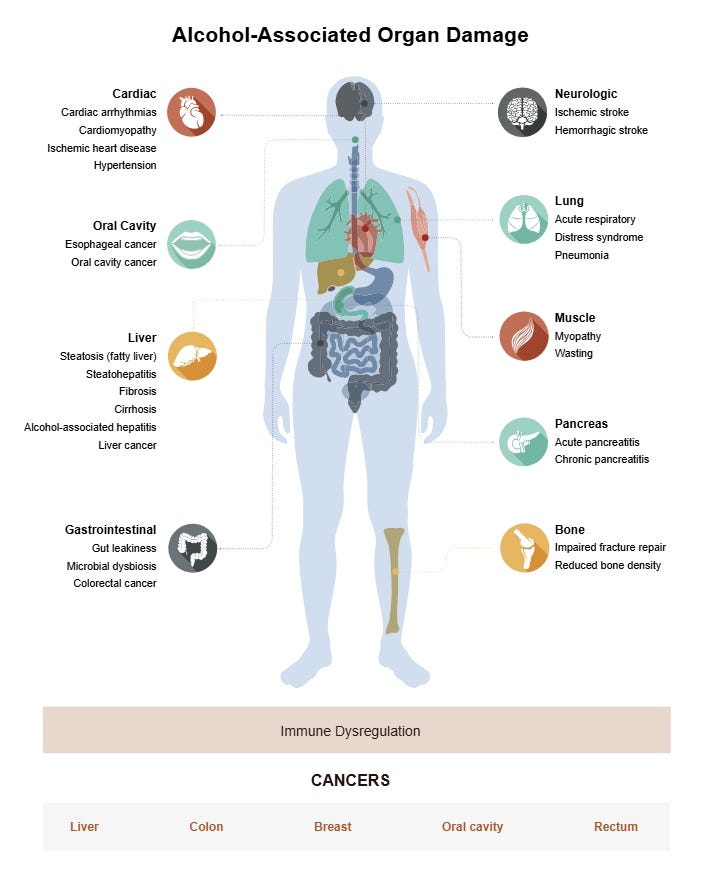
We’ve heard about the negative effects of drinking, but did you know that you don’t have to be an alcoholic to experience them? Even modest drinking impacts nearly every system in the body by increasing risks to your brain, liver, heart, and long‑term well‑being.
Drinking alcohol disrupts brain communication pathways by affecting your mood, memory, coordination, and decision‑making. This explains that feeling of being ‘drunk’: slurred speech, impaired motor skills, lowered inhibitions, and altered mood.
Alcohol also raises your risk of stroke, high blood pressure, heart disease, and depression by causing anxiety.
Heavy drinking can lead to irregular heart rhythms, cardiomyopathy, and a higher chance of a heart attack.
Cardiovascular problems are one of the most serious long‑term risks of alcohol use. Alcohol disrupts the cardiovascular system.
Mounting evidence shows that alcohol contributes to several cancers, including breast cancer, liver cancer, cancer of the mouth & throat, and colon cancer.
And as you probably already know, your liver has the job of metabolizing all that alcohol you drink. It can only process small amounts of alcohol at a time, which explains why those who drink in excess tend to suffer from cirrhosis of the liver, fatty liver disease, or alcoholic hepatitis.
Alcohol affects the digestive system and leads to ulcers, gastritis, and pancreatitis by irritating the stomach lining.
I think you get the point! Alcohol causes a cascade of harm, both short and long-term.
You might be like me, despite being armed with all the facts and knowing all the risks, you’re about to pour a glass of wine. We only live once, right? YOLO. So why change things now, you ask?
Why not? What have you got to lose? I know you’re curious.
For one, you stand to lose the extra weight gained from alcohol’s empty calories and those chips you ate after drinking and getting the muchies.
Let me recap everything you stand to gain:
Restorative sleep: Alcohol disrupts REM sleep
Energy: You’ll wake up more energized
Extra Cash: You might find yourself with additional funds
A healthy liver!
Sharper Memory: Drinking clouds concentration and short‑term recall.
Most importantly: heart health
Dry January is not a lifetime commitment; it’s only one month.
Look at it as a test of your willpower, a health reset, and a peek into the benefits of 31 days without alcohol. It’s a low-risk experiment.
That’s the way I’m looking at it. In the meantime, I’m building up a collection of non-alcoholic beers to choose from. With the growing movement and social acceptability of not drinking, you can find a large variety of non-alcoholic beers. I’m excited to try them.
I’d like to know and experience for myself how it feels to be without alcohol for a month.
Above all, I’m eager to see the effects on my belly. Hopefully, the lack of alcohol, combined with my workouts and focus on whole foods, will return it to its pre-menopausal size.
As the new year begins, when we’re all looking for ways to reset, recharge, and renew ourselves, one of the simplest yet most powerful steps we can take together is Dry January. 31 days without alcohol.
It’s not about giving up forever; it’s about giving ourselves the chance to see how good life can feel when we step away from the nightly glass of wine, or in my case, beer.
The goal of Dry January isn’t about restriction; it’s more about freedom. Freedom from hangovers, freedom from sluggish mornings, freedom from the cycle that keeps us from living at our fullest potential.
I’m inviting you to join me in this challenge. Together, we can support each other, share our wins, and celebrate the clarity and strength that come with thirty-one alcohol‑free days.
Think of it as a reset button for your body, mind, and spirit. By February, you’ll not only feel the difference, but you’ll know you’re capable of more than you imagined.
Let’s make this January about health, resilience, and self‑discovery. Say yes to yourself. Say yes to the Dry January Challenge.
2 Responses
Looking forward to the challenge.
Looking forward to the challenge